
The Sovereign Food Safety Ledger: Interconnected National Blockchains to form a Global Framework
Introduction
The global food supply chain is under consumer scrutiny for accountability, food safety and accountability; with good reason. Food borne diseases pose a significant public health challenge causing approximately 600 million cases of illnesses annually. Regions like Africa and Southeast Asia bear a heavy burden caused by weak food supply chains and fraudulent food safety practices such as the harmful arsenic levels in rice from South Asia, found to be above the permissible limits and the infant milk scandal in East Africa. These issues are caused, significantly, by reliance on mutable databases and unilateral trust models that are prone to tempering, delays and geopolitical dependencies. Most digital traceability platforms are controlled by North Western or European corporations, creating an asymmetric dependency for emerging economies. National food safety information may be stored on foreign cloud infrastructure, thus exposing countries to extraterritorial jurisdiction and potential service denial under sanction regimes.
A network of national interconnected blockchains combined with interoperability protocols promises major technical credibility and social-political acceptance in development and deployment of an inclusive and safe global food system.
This essay explores the idea of an Interconnected Sovereign Food Safety Ledger defined as a distributed, cryptographically secured network of national blockchains as a geopolitically acceptable mechanism of global food safety. The decentralization feature of blockchain technology makes data immutable, time stamped and cryptographically provable; resulting in distributed trust, which is much needed in food safety now more than ever.
A New Model of Food Safety Verification
The Sovereign Ledger is a distributed blockchain-based record of food safety events, laboratory tests, certifications and validations that is governed by trading nations, designed for interoperability and stores data cryptographically in an immutable state. This is a comprehensive traceability system that keeps accounts of the food safety events at every stage from production to consumption, making this information available to all integrated national blockchains. It has neither features that define a public blockchain nor corporate private databases and could be deployed as either a Consortium or Hybrid ledger. The key principles of the framework include:
-
Sovereignty: each trading nation operates its own validating nodes, stores and manages keys in data centers under its jurisdiction using domestically approved cryptographic standards. No third-party foreign cloud-based services are employed.
-
Interoperability without Data Exposure: verification of foreign certificates is done without absolute data disclosure by employing a federated protocol based on zero-knowledge proofs and inter-blockchain communications. For instance, a laboratory in country 1 could prove aflatoxin absence to country 2’s customs offices using this protocol while preserving proprietary methodologies.
-
Auditability and Selective Transparency: commercially sensitive information remains classified, while compliance proofs are publicly verifiable, time-stamped and non-reputable.
-
Distributed Trust and Parity Governance: unlike the current system, the ledger places trust in the underlying mathematics as opposed to foreign or private corporate institutions. There exists not a single super nation with majority stake and power either. Governance of the ledger is by equal entities at parity.
-
Distributed Validation Model: competent state licensed entities; agricultural ministries, food safety authorities, laboratories and customs services perform the validations, integrating event recording through smart contracts for real-time traceability.
-
Event Recording and Smart Contracts: events are anchored on-chain. Compliance checks and issuance of export certificates are automated by self-executing smart contracts where agreement terms are embedded in the underlying computer program.
-
Digital Identity Layer and Cross Border Verification: all supply chain actors receive sovereign decentralized identifiers issued under national public-key infrastructure. Zero-knowledge succinct proofs allow an importing country to confirm that import batches satisfy all required tests without accessing raw laboratory data or commercial details.
This high level design draws from established blockchain consensus protocols adapted for food supply chains, with an emphasis on preservation of privacy. The append-only feature of the ledger allows constant and real-time traceability of food safety claims by all member nations, authorities, producers, consumers, etc.
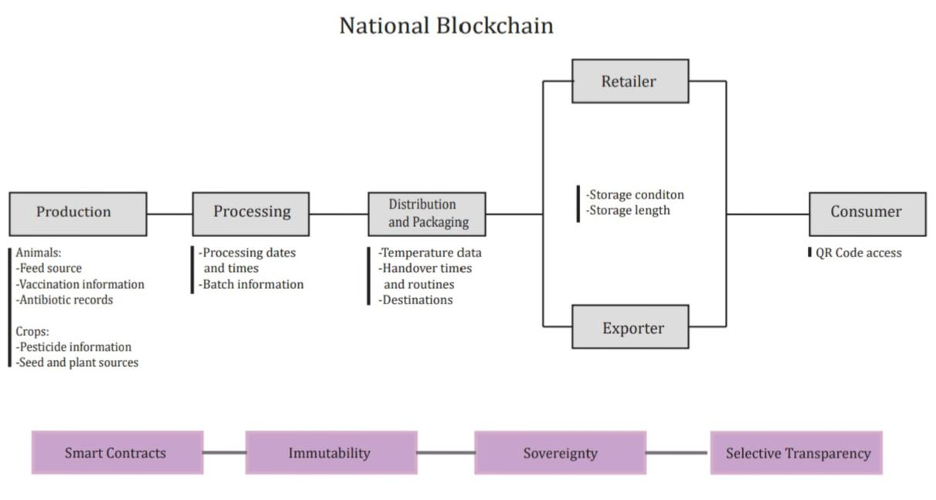
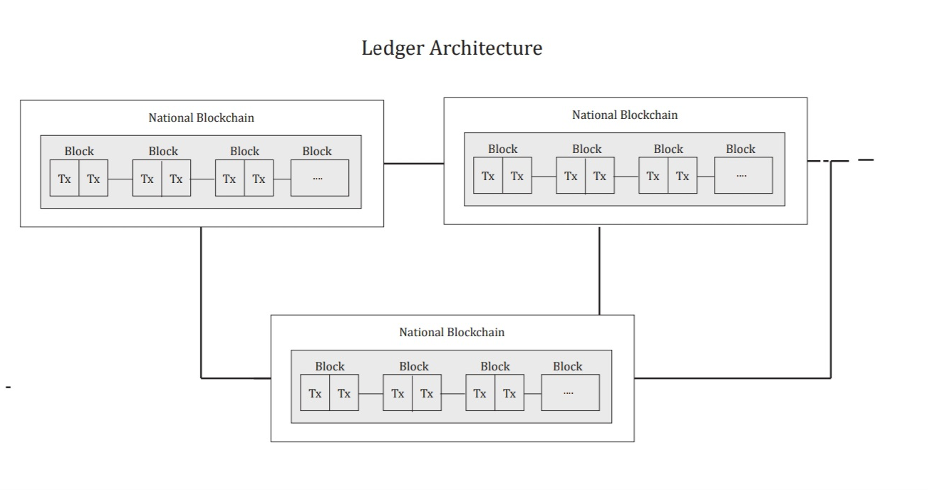
 Schematics of proposed Sovereign Food Safety Ledger comprised of National Blockchains
Leveraging Existing National Blockchain Infrastructure
Development may begin with protocols like Cosmos and Inter-blockchain Communications (IBC), customized for state-level cryptography. Pilot initiatives such as China and Brazil’s blockchain-based traceability for beef from origin to export demonstrates practical benefits with consumers willing to pay premiums for verified products. Russia’s National Masterchain platform supports business and financial transactions and could be extended to food certifications. India’s National VeChain Blockchain platform promotes governance applications that could be used for food safety implementation pilots for tamper-proof traceability. The United Arab Emirates’ Blockchain Strategy, Nigeria’s eNaira infrastructure and Brazil’s blockchain network are all promising initiatives that could be integrated into a global food safety ledger which could operationalize interconnected nodes covering a significant part of global trade with investments in and development of such infrastructure by prospective member nations.
Economic, Geopolitical and Food Safety Implications
Blockchain technology enables traceability that directly translates into transparent food safety management, while the immutability of the ledger eradicates fraudulent practices through improved compliance. By including records of Hazard Analysis, Good Agricultural and Manufacturing Practices and adherence record. Thus the interconnected Sovereign Food Safety Ledger revolutionizes global food safety. The ledger could also yield substantial improvements in food safety and traceability. This transforms trace backs from days into seconds through event logs and smart contracts. Smart contracts also enable the blocking of contaminated shipments at import borders through automated customs flags while keeping it visible on the ledger to all integrated blockchains. It may also unlock additional agricultural exports and reduce extraterritorial sanctions and premiums on insurance by provable compliance and in pilot cases has reduced customs clearance times. Early adopters have the potential to gain standard-setting influence within geographical region blocks and strengthen positions in global trade disputes through mathematically indisputable evidence.
Conclusion
In the current era of supply-chain disruption, strategic autonomy and deliberate fragmentation of the global economy, food safety verification needs not to be dependent on fragile institutional trust, foreign databases and servers or multinational platforms that focus on shareholder value rather than humanity’s prosperity. The Interconnected Sovereign Food Safety Ledger offers the multipolar solution required for food safety; a scalable, mathematically verifiable technological alternative that preserves sovereignty and improves food safety standards while enabling frictionless global trade, eliminating profit-driven monopolies and most impotently preventing millions of illnesses and deaths caused by food contamination. The state-of-the-art requires prospective member nations invest in national blockchain capability as the first step towards multipolar food safety improvement.
Bibliography
-
Adesiyan KT (2025) Blockchain technology: a game changer for food traceability and security. IOSR Journal of Business and Management (IOSR-JBM) 27: 1–8. https://doi.org/10.9790/487X-2701050108
-
Bank of Russia (2016b), October 5, 2016 the Central Bank of the Russian Federation announced the launch of its own blockchain platform “Masterchain”, translated from Russian. Available: http://www.tadviser.ru/ (Accessed: November 27, 2025). Original in Russian: 5 октября 2016 года ЦБ РФ объявил о запуске собственной блокчейнплатформы «Мастерчейн» / Банк России.
-
Central Bank of Nigeria: Enaira, eNaira | Central Bank of Nigeria. Available at: https://www.cbn.gov.ng/currency/eNaira.html (Accessed: 29 November 2025).
-
Cosmos, The internet of Blockchains. Available at: https://cosmos.network/ibc (Accessed: 25 November 2025).
-
Emirates blockchain strategy 2021: The official platform of the UAE Government. Available at: https://u.ae/en/about-the-uae/strategies-initiatives-and-awards/strategies-plans-and-visions/strategies-plans-and-visions-untill-2021/emirates-blockchain-strategy-2021 (Accessed: 29 November 2025).
-
Nakamoto, S. Bitcoin: A peer-to-peer electronic cash system. Available at: https://bitcoin.org/bitcoin.pdf (Accessed: 26 November 2025).
-
Tian, F. (2016), An Agri-Food Supply Chain Traceability System for China Based on RFID & Blockchain Technology, Department of Information Systems and Operations, Vienna University of Economics and Business, Vienna.
-
VeChain Sync. [Online]. Available: https://env.vechain.org/ (Accessed: November 25, 2025)
-
Website oficial (2025) Blockchain RIO. Available at: https://blockchainrio.com.br (Accessed: 25 November 2025).
-
World Health Organisation: Estimating the burden of foodborne diseases. Available at: https://www.who.int/activities/estimating-the-burden-of-foodborne-diseases (Accessed: 25 November 2025).
-
Zhejiang Food Traceability Chain Case Study. Available at: https://www.gs1.org/system/files/gs1-china-zhejiang-food-traceability-chain-case-study_1.pdf (Accessed: 30 November 2025).
