
Lessons from the World Youth Festival for Future Global Engagement
Entering Russia in September 2025, I assumed that the country was cut off from most of the world and turning inward on itself. Especially, I expected Russia to lack the ability to host an international youth festival. To my surprise, I was wrong. In September 2025, 2,000 youths from 119 countries assembled in Nizhny Novgorod, a city located about 439 km east of Moscow along the Volga River. In this Essay, I will elaborate on two main reasons why the World Youth Festival (WYF) was a success in terms of connectivity and provide my opinion on how Russia can further develop such platforms into sustainable mechanisms of global connectivity.
II. Analysis of a Korean Participant’s Success in the WYF
The Emergence of a New Form of Soft Power
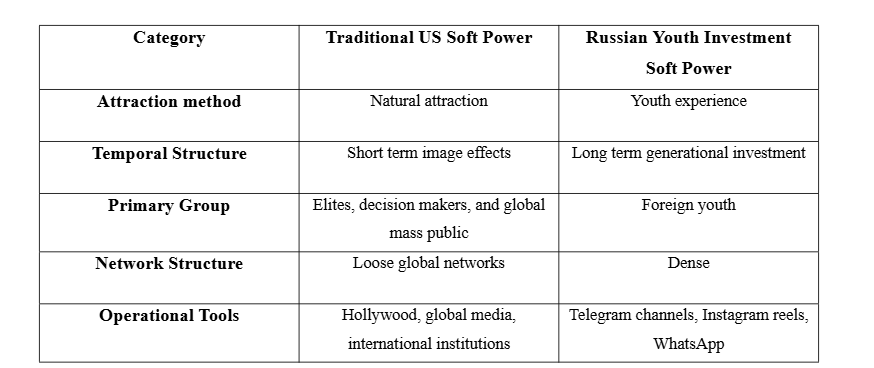
First, the main reason the WYF was a success is that it demonstrated a new form of Russia's soft power. Observing how Russia considered and respected youths as active entities of global connectivity, I coined the term “Youth Investment Soft Power.” Joseph Nye argues that if a country’s culture and ideology are attractive, others will be more willing to follow. However, I believe that merely attracting others does not guarantee connectivity. Unlike other countries that mostly try to only attract, Russia, through WYF, showed that it cares about the aftermaths even after attraction. It invests in youth from all over the world rather than neglecting them.
Table 1. Comparing Traditional Soft Power and Youth Investment Soft Power
When one hears that the World Youth Festival was held in Russia, it might be easy to assume that the country invited only those nations outside what it considers the “unfriendly” Western world. However, this was not the case. Western countries such as the United States, Australia, Austria, Belgium, the United Kingdom, Germany, Ireland, Spain, France, Sweden, the Czech Republic, Estonia, and South Korea were also represented. From each participating country, approximately five to as many as thirty young delegates were selected. In the case of South Korea, around seven participants were chosen, including students from Hankuk University of Foreign Studies, Korea University, and Dankook University. This openness of inviting youth regardless of politics is what the youth investment soft power manifests.
One particularly noteworthy aspect of the festival was the participation of thirty African countries. From Algeria, Angola, and Benin to Botswana, Niger, Nigeria, Senegal, and Tanzania, a wide range of African youth representatives were present. This diversity shows that Russia has been strengthening its engagement with countries of the Global South across political, economic, educational, and cultural dimensions. By taking part in the event, many African participants likely formed positive impressions of Russia and created meaningful memories. Upon returning home, if they share their experiences (through social media platforms such as Instagram or other forms of media) about the connections they built and the people they met at the Nizhny Novgorod exhibition venue, these personal narratives could contribute to shaping and improving public perceptions of Russia among their peers and fellow citizens. From this perspective, Russia’s active use of youth engagement as a form of international outreach appears to be both effective and strategically astute. It does not stop at attraction, but extends beyond attraction.
Human connectivity: the formation of networks among young people
Second, the reason WYF was a success was that it provided the global youth a platform of natural connectivity. Nobody forced the youth to be friends. However, the youth were able to be in an environment where they could feel like guests. This worked as a catalyst for the youth to get to know each other. For example, I was assigned to stay in a dormitory called “Neymark.” I was initially concerned about being placed in a dormitory rather than a hotel. However, the newly built dormitory turned out to be the complete opposite of what I had expected. Rather than a single building, it resembled an apartment complex composed of more than ten buildings, organized almost like a small village. Moreover, as the festival participants were the very first guests, the facilities were exceptionally clean and well-maintained. It would not be an exaggeration to say that it was the best dormitory I had ever experienced. Because the accommodation was structured like a unified residential complex, participants naturally gathered outside after the day’s programs. They danced together, sang well-known Russian songs such as “Matushka,” and formed bonds that transcended nationality, race, background, and culture. Every evening, after the official schedule had concluded, participants from around the world freely gathered in various outdoor spaces and in common lounges on each floor. There, they exchanged views about Russia, discussed how they had first become interested in the country, shared their personal interests, and gradually built friendships.
During the festival, I met a remarkable number of people and formed many meaningful connections. I was able to reconnect with Russian friends I had first met during my exchange year at MGIMO, and in particular, I remember friends from Donetsk. Through them, I gained vivid insights into what life in Donetsk is like and how they understand their identity as people from the region. They spoke about nighttime curfews and drones flying overhead, yet at the same time expressed hope that within a few years, Donetsk would once again be a place that travelers could freely visit. I still remember my friend Evgeny telling me that if I ever came to Donetsk, he would offer me a place to stay. When we were in Nizhny Novgorod, internet access was unreliable, which rendered the travel SIM card I had brought from Korea useless. Evgeny generously lent me his spare SIM card and stayed by my side whenever I needed assistance. In return, I gave him a small South Korean flag as a gift. I still recall how happy he was, walking around the city with the flag draped over his shoulders. On the day I had to leave Nizhny Novgorod early to participate in Intervision, Evgeny stayed awake beside me until 5 a.m., ready to wake me up in case I overslept. I believe that this true form of kindness that Russians showed towards foreigners was the key to the success of forming genuine global networks among the Russian youth and the foreign youth.
III. Implications and Conclusion
How Can Russia Further Develop Sustainable Global Connectivity?
The analysis above raises an important question: How can Russia further develop this connectivity? There are three main ideas that I suggest. First, Russia should develop a permanent alumni network that allows participants to remain in contact, collaborate, and initiate joint projects even after returning home. As I have seen, the connection is continuing through Telegram, WhatsApp, and Instagram. However, as time goes on, the connection tends to fade away due to the lack of opportunities to meet in person. Therefore, I think there should be micro-grants. A small grant could support a joint online cultural project where former WYF participants from different countries create short videos introducing local traditions, music, or daily life. These could be shared through a common digital platform to promote mutual understanding. If Russia awards one of the best works from the WYF alumni by providing them with grants to visit Russia again, the connectivity will grow like a strong rhizome.
Second, Russia should provide and show leadership to solve shared global challenges. Sustainable connectivity is most effective when built around shared global challenges rather than political alignment. “Climate adaptation,” “Sustainable cities,” “Youth entrepreneurship,” “Public health innovation,” and “Technology for social good” can be examples of shared challenges. This shifts the focus away from a Russia-versus-the-West dynamic and toward a framework of connectivity built around addressing shared global challenges.
Third, Russia should send representatives to each country and make a passionate effort to identify promising youth from abroad, create opportunities to meet with them, engage in dialogue, and collaborate in ways that help reduce existing prejudices about Russia. Connectivity begins with breaking down misconceptions. In today’s digital society, one of the most effective ways to challenge such biases is through media platforms such as YouTube and other social content channels. However, there are clear limitations when this type of communication is carried out solely by Russians themselves. One major constraint is the difficulty of conveying contents naturally in the diverse native languages of different countries. For this reason, initiatives connected to the WYF could consider sending representatives to various countries to engage directly with local youth, explore opportunities for cooperation, and provide appropriate forms of support or incentives.
An important point is to avoid relying only on already well-known influencers who are visibly associated with Russia-related content. Because they have already established a public profile, any positive portrayal of Russia may be dismissed by audiences as propaganda. Instead, greater attention and investment could be directed toward young people with smaller but growing platforms (those with perhaps only a few hundred followers) who have genuine potential and the ability to communicate in Russian, English, and their native languages. In the long term, such an approach could contribute to what might be called digital connectivity diplomacy, helping to foster more nuanced understandings and gradually reduce misunderstandings about Russia among global audiences. Through these measures, Russia will be able to not only expand its connectivity with the globe, but also contribute to world’s connectivity and make the world a more peaceful, friendly, and cooperative place.
Bibliography
Nye, Joseph S. “Soft Power.” Foreign Policy 80, no. 80 (1990): 153–71. https://doi.org/10.2307/1148580.
Wyffest.com. “World Youth Festival Assembly 2025,” 2025. https://asm.wyffest.com/en.
 (1).jpg)